Showing posts with label Lucky Dip. Show all posts

Wednesday, August 31, 2011

Using quarantine as a barrier to trade


I have been meaning to write about using quarantine as a barrier to trade since Queensland’s banana crop was destroyed by cyclone Yasi last summer and prices at the supermarket shelf hit $14/kilo and more. It seems that leading economist Saul Eslake, and economist turned politician Andrew Leigh, have done the job of deciphering genuine concerns over importing disease, and rent seeking by protected producers.

Let us start with what Andrew had to say.

In fact, just about every trade barrier can be rewritten as a quarantine rule or a consumer protection law. Suppose Californian wine producers are complaining about competition from French Bordeaux. Left unchecked, US authorities could simply raise health concerns about Phylloxera, and ban French wines on quarantine grounds. Or imagine that British carmakers are struggling to compete with Malaysian hatchbacks. Without any international guidelines, there would be nothing to stop the UK from banning Malaysian small cars for reasons of safety.

To prevent competition laws and environmental rules from being used as backdoor protectionism, the WTO has two new treaties that require health, consumer and environmental regulations to be scientifically based. National regulations cannot discriminate against particular countries, and must not impede trade any more than necessary.

If a WTO member thinks that another country is breaking the global trade rules, it can take a case to the dispute panel. Australia has complained to the WTO on seven occasions (against the European Union, Hungary, India, Korea, and the United States). We’ve won five of these cases, including decisions in favour of our beef exporters to Korea and our lamb exporters to the US.

On the flipside, we’ve had ten cases brought against us (by Canada, the EU, New Zealand, the Philippines, Switzerland, and the US). We’ve lost three of these cases, including the New Zealand apples decision (the other two losses related to imports of salmon and automotive leather).

Andrew makes the solid points that quarantine and consumer protection is ‘back-door’ protectionism, and gives a good overview of the international legal framework around trade.

Saul Eslake takes different approach by discussing the price impacts on domestic consumers from this type of protection. He also highlighted that in the wake of cyclone Yasi, high banana prices were only helping banana growers whose crops weren’t destroyed, not those who actually lost their crops from the cyclone.

On the matter of importing diseases, he makes a point I have argued to many people in the past. How would diseases go from boxed-up fruit and vegetables arriving in city ports out to farms? How high is that risk? In Eslake’s words-

If bananas and other fruit or vegetables are imported into southern ports, such as Melbourne, Adelaide or Sydney, and are subject upon arrival to appropriate inspections, they are no more likely to spread diseases damaging to Australia's banana industry than the importation of cooked and packaged Canadian salmon has done to Tasmania's salmon industry (another example of protectionism masquerading as ''biosecurity'' where, unusually, commonsense and the interests of consumers ultimately prevailed).

To me the irony of the situation is that most of the crops now requiring protection from foreign pests are imported themselves, and could arguably be classified by an environmentalist as a foreign pest.

The other irony is that the countries that do have these diseases are also exporters and can produce the crop much cheaper than us.

The logical person would ask whether the potential costs from the pest or disease are greater than the benefits derived by consumers from cheaper food? If yes, then we should keep the quarantine restrictions. If no, we should drop them.

I am not trying to say here that all quarantine rules necessarily have greater benefits than there costs. But we have lost 3 out of ten cases brought against us by other WTO member, so if 30% of the quarantine rules can be dropped because their costs outweigh the benefits, that would be good for everyone in the long run.

Thursday, August 25, 2011

Not so random links, comments and quotes

 
Law of demand holds
Bust fares go up, patronage goes down. A lesson for policy makers about defining their outcomes better – do they want cost recovery for transport (higher fares, lower usage), or are they willing to subsidise public transport to save costs of maintaining the road system?

Algorithms rule our lives
The algorithms of Wall Street may be the cyber-equivalent of the 80s yuppie...
The question for the economist is not whether there are downsides to this infiltration, but whether the costs outweigh the benefits. I am pretty sure that is not the case yet – after all, algorithms are written by humans, redesigned by humans, and often ignored by humans.

Culture -
The Misconception:  You celebrate diversity and respect others’ points of view.
The Truth: You are driven to create and form groups and then believe others are wrong just because they are others.

If patents over software are a bad idea, why not all patents?
This article argues that companies find it more attractive to make money suing each other for infringement than actually making things.

The question for society is whether innovations would occur at close to the same level without patents? My personal view is that they would, and that a possible first mover advantage would be reward enough. A short, but very useful, free online textbook on the economics of patents and copyright is here.

Apple iPad patent fiasco

Free trade in apples, finally?
As I said before with food import restrictions, if prices are set by global markets, domestic buyers cannot buy at prices below the export market price - although they could perhaps be higher.

Essentially, by protecting our producers from import competition we are paying HIGHER prices for Australian food than foreigners are paying for Australian food.

Of course apple growers will whinge, but they will adjust over time, and in reality, their incomes have been protected for a long time anyway.

Warren Buffet supporters in France - the rich want to be taxed more

Quotes -  
Graveyard market - buyers don't want in, sellers can't get out (ht: doomsday_trader)

After all, statistics are like bikinis. What they reveal is interesting, but what they conceal is more important (ht: John Booth)

If an Axe is being ground, cluelessness will follow naturally. I used to be an ideologue and as I think back on my unreflective self, I remember that I just chose to devote all my mental energy to what I wanted to believe and none to what I didn't want to believe and the result was I appeared clueless, sometimes intentionally clueless (ht: anon)

The lesson of Alaska is never give away land, even when it is seemingly worthless (ht: M)

Monday, August 22, 2011

Electric v petrol scooter


I've been reading some great posts recently at Chris Eastwood's blog in my view... . Below is a full post comparing the merits of electric and petrol scooters in a detail rarely seen.

But first a few quotes from Chris that might get you interested in some of the ideas floating around on his blog.

By having an increasingly itinerant population is it any wonder that no one gives a rats arse that your home is being degraded? (here)

I recall a conversation with 2 educators on Fraser Island ... that the last thing you want to do is encourage more people to come to national parks, even if it does somehow liberate more funding from the government it won't pay for the extra damage caused by the extra bogans. (here)

The full electric scooter post is below, and the original link here. Chris finds that the electric scooter produces more greenhouse gas emissions than the petrol version. Please keep in mind the rebound effect, since the electric scooter is so much more expensive (the owner can’t spend that money on other goods).

Over to Chris.

It’s starting to get fashionable to talk about Electric Cars again. The other day I was in at the local scooter shop the other day getting a tyre sorted out for my Yamaha T-Max scooter (and pondering a new 50cc scoot for my wife) when I spotted this electric scooter. So (being an engineering sort of fella) it is exactly in my nature to use this situation to mull over the whole thing (and present it to people who may not have thought about it).

I have been interested in the concept of an electric scooter for a while now but had not really done much research on the topic.

So since it was right in front of me I thought I'd ask some questions, take some pictures and write about it here.

I will say from the start that I like the idea of an electric scooter for city work more than petrol ones for the simple fact that most scooters are 2 strokes, stink and pollute something fierce.

India made a great move when they legislated their nasty "auto" taxis to use CNG rather than the regular 2 stroke ones of the past. Emissions fell and everyone is healthier and happier for it.

Its true that electric engines will need power from the regular power stations, which are in the main coal fired (at least in Australia). However at the very least we move this pollution to a single more efficient generation source (while introducing a number of other inefficiencies in the middle) which can be more controlled and monitored.

Before dribbling on about that too much I thought I'd toss in a comment about the rear drive on the scooter. A brush-less 48Volt 4000Watt hub mounted motor: man that means it can suck 83 amps!! wow

Which makes for some interesting observations about the changes in engineering of the swingarm and frame (because the forces are different now).
The motor can suck up to 4000 watts of energy out of your buttery but of course will only pull as much as is needed for keeping a constant speed when cruising along at a steady speed (say 50Kmh). This is of course exactly like a petrol powered motor, which sucks fuel faster when pulling power than does when cursing along. Interestingly both produce about 4000 Watts of energy (yes, 49cc scooter or electric scooter give you the same power to take off) which should come as no surprise because thats regulated by government.

[aside: to put this sort of tiddly power delivery into perspective, a "vanilla" motorcycle like a Suzuik GS500 has a motor that will deliver at least 38,000 Watts and a timid car like a Ford something like 48,000 Watts of power. So as things go the electric scooter is not pushing the engineering envelope here]

Putting energy in:

People somehow think of petrol as fuel and electricity as energy, I blame our schools for creating this schizophrenic view of reality. The reality is that fuel (petrol, gas) is energy in liquid form. We release that energy by burning it.

Motors turn that energy release into movement. The electric bike stores energy in rechargeable batteries and gets the energy to recharge the battery from your wall socket using something like this:

This little device (which is about the size of a small shoe box) is the charger for the scooter.

To charge your scooter up you have to plug this in to the wall power and into the bike. You cannot really run a long extension lead to it or you will lose power so we meet:

Problem #1 - where can I recharge


If you have your own house and garage you can probably charge it up in your garage, but if you live in an apartment its quite unlikely you have power available where you park your scooter. So you'll need to find a place where you can park it and recharge it: which takes 4 hours. In contrast the regular scooter recharges with fuel at the local servo and takes about 5 minutes to fill and pay for.

So, with fuel being (at the time of writing) about $1.5 a Liter a petrol powered scooter takes about 5L in the tank and will set you back about $7.50 to fill up from dead empty. It’s unlikely you'll run it dry, so you'll probably put in 3L at a time and walk into the servo to pay your $4 bill while grinning at the people who fill up their cars and are paying something like $60 for that.

So what does it cost to "fill up" the Electric scooter?

Well of course electricity costs, in my area right now power you pull out of the wall costs you about 19c per 1000 watts per hour. It’s normally written as Kw/H which seems to confuse people who often profess to not understand their power bill. It’s not all that had to get. Essentially if you plug in and turn on something which uses 1000W (or a kilo watt or 1Kw) and leave it turned on for an hour it cost you 19c.

So how does this apply to the Electric scooter?

Looking at the charger we see that it supplies about 900Watts to the battery. I'm certain it is not 100% efficient so let’s give it some grace and assume that it’s going to pull out 1000Watts of power from your power point in your home (or wherever its plugged into).
So (based on the above rate for power) a 4 hour charge will cost you something less than a dollar, 78c our thereabouts.

According to the information I have on the scooter (which you can verify here) For this princely sum you get to travel 90Km (only under particular conditions).

That is quite attractive. Sounds like its quite positive when reading the basics. So let’s plumb into the ownership and do a little bit of thinking:

Cost comparison
Ok, so 80 cents gets you 90Km on the scooter, but it will of course vary on how you ride and in what conditions. 90Km is of course also the maximum distance, so if you commute across town 25Km you'll not quite get two trips into the one charge (as 50 + 50 will put you out of battery) and you can't stop and top up on the way like you can with a petrol bike. The actual distance you will get may be less depending on factors like:

· hills
· number of traffic lights
· how heavy you are on the throttle on take off (kiss bye bye to fast take offs)

This means that (unless you want to be pushing it home) you'll have to top up every day (fine if you park in a garage in your home, annoying if you have a flat).

So again you'll be plugging in and paying that 80c every day instead of the potential discussed by the maker and seller of the bikes.

If you were to consider a petrol scooter (as a comparison) such as the Honda Scoopy, assuming you get something like 3l / 100Km (and some have suggested you can get 1.4L/100Km) you will pay $4.50 for that 100Km or $2.25 per day. That’s a worst case scenario too, as if you get 1.5L/100km (which is actually likely) then that'll be more like $1.12 for the trip.

Starting to look like much the same running cost as the 80c for the scooter isn't it?

Of course with the petrol version you have the flexibility that you KNOW how much is in your fuel tank, battery charge level is not as accurate and will depend on how cold it is. You can top up your fuel in minutes but need hours (back home where your charger is) to top up the electric scooter.

So this begs the question of how much is the convenience that petrol provides worth to you?

Back on the costs: an acquaintance of mine who has an electric bicycle (less power) recently changed battery from the standard one. How much? Well think in numbers closer to $1000 than $500 and you're on the path.

So unless you're after a battery for one of those tiddly little electric bicycles (with all that implies) you're thinking big money. This starts to lead into the next problem identified for the Electric Scooter and that is:

Problem #2 real operation costs:

Thinking about the above battery example, how long will your rechargeable battery last? Well its only covered by 1 year warranty. So assuming you use the battery optimally (charge and discharge according to the makers ideals) you'll certainly get a year out of it, perhaps two. But are you going to learn to do that or is convenience going to get in the way?

Consider that at the fuel prices of $1.50 /Liter (and before you say that may rise over 2 years ask yourself if power won't) you will get 20,000Km of travel from $450 of petrol.

If you travel 25Km each way to work, thats 50Km per day = 400 days of travel.

Yes, that's right ... your entire year of fuel bill will blown on a battery replacement. Which means in another way of thinking about it, that you are actually costing yourself an extra 80c a trip just for the hell of it when using an electric scooter.

Ok, but we're CO2 free right? That's got to be worth something hasn't it? Well, let me introduce you to ...

Problem #3 - CO2 generation

Its hard to get figures but it seems that (for coal powered stations) about 900g of CO2 is released for every Kw of electricity. So given that the Electric Scooter will need about 4Kw from the wall every day (using the above situational example) it will thus end up generating about 3.6Kg of C02. Of course you could run it to the edge and charge every second day (and push it home occasionally) halving that figure, but that's up to you (and pushing is good exercise).

In comparison burning petrol will release about 625g of C02 for every litre burnt, so assuming you burn 1.5 litres for your 50Km trip you'll generate about a 1Kg of C02 (Note: these calculations are based on figures for C02 in petrol from here)

so yep ... the petrol version generates less CO2 as well. It’s not looking good to me at this point ...

Naturally at this point someone will make the observation that Electric Scooters are at the beginning of their evolution and that petrol engines benefit from decades of development. Well if you have never gone to school or been taught to do any reading you may believe that line.

Let me assure you that both are quite developed technologies.

Petrol motors are actually not significantly advanced compared to 40 years ago (only we've worked on mainly curbing their emissions of other stuff) when you could buy a 70cc Honda Cub (lovely scooter) which used almost exactly the same amount of petrol as the bikes do today.

Then there is the Brushless DC motors used in the scooters, these have been in commercial use since 1886. So its mainly the battery technology which is changed to make storage more compact and perhaps controller circuits to make the motors more flexible. The basic physics of power required to move something hasn't changed between the motor types.

This does not effect the cost and pollution aspects of this calculation (except to say that modern batteries may be a more significant pollution issue than lead acid batterys).

Problem #4 - capital costs

Right now (if you look closely at the first picture) you'll see that an electric scooter equivalent to a 50cc scooter costs about $4250, while a 4 stroke *(more expensive, much cleaner burning less polluting than 2 stroke) Honda Scoopy will cost you about $2500

Yes, you did read that right, you'll pay nearly double for an equivalent electric scooter which will likely produce as much C02 (if that's of interest to you) and certainly more other significant toxic waste than will the choice of a clean 4 stroke petrol powered scooter (compared to 2 stroke motors which are quite dirty creatures).

An excellent document prepared for the Victorian Competition and Efficiency Commission (here) suggests that scooters are more effective people movers than cars are in cities. No surprise there...

To make the case even more for scooters, according to that same report: "A 2000 report (Motorcycle Transport, Powered Two Wheelers in Victoria) by transport researcher, Professor Marcus Wigan, found that motorcycle riders were the only transport mode to indicate no time delays as part of a trip."

There are articles available written to counterpoint this blog post (such as this one) where they suggest that Electric bikes are better than petrol powered ones. It’s worth noting that these are largely written by people who actually sell the electric alternative (but not the electricity).

It’s interesting to note that in the post I cited above the author makes the comparison between a electric bicycle and a postie bike (Honda CT110). The CT110 is a work horse, it'll carry another 40kg of mail and still accelerate and travel at 60Kmh if you desire, but the author makes a disingenuous comparison with an electric bicycle (which only carries you and you have to pedal too) comes out on top (when he ignores the battery issue). Yet the bicycle has a motor which wouldn't have enough power to pull the skin of a custard when compared to a postie bike ... gosh, bet that'll be popular on the farm!

But what about Solar charging? That would be CO2 free...

Well that's a good point. If you were to get a 1.5 Kw system it would likely produce enough energy on a good day to charge your scooter (if you left it at home) within 5 hours (you don't get 1.5Kw all the time out of them, ask someone who owns one). So for the additional investment of $2500 (around about and you won't be back feeding the grid while your charging) you can be comfortable in the knowledge that you won't pay that extra 80c a day (but you'll still pay the other costs)

So that's $4200 for the scooter, and $2500 for the solar charger system (no rebate on that one) taking your investment to $6700 for a system which needs you to leave the bike home during the day for charging ... sounds great to you too?

So in summary:

It seems like the following to me

· I will save a little per trip (about 80c for a 50Km trip vs $1.25)
· but I pay double to purchase ($4200 vs $2500)
· unknown depreciation losses (but it’s fair to say you can't lose more than $2500 on the petrol scooter)
· pay more for operational costs (the battery will die)
· actually create more pollution in almost every way by using an electric scooter over a petrol one.
· You have to be able to park it where you can charge it (in a secure place or risk getting your charger stolen)
· if your running low in power on the way home you cannot just stop in to a servo to top up.

Why are you buying the scooter? Economy? Environmentally friendly?

The bottom line is if you want to be really environmentally friendly, go get a 50cc to 110cc 4 stroke scooter stop driving your car and help save the world’s atmosphere and resources.

Thursday, August 18, 2011

Friday thoughts


Democracy

In a democracy, we put political power into the hands of some and try to limit the damage they will do as much as we can by putting all the obstacles we can think of in their way while giving them the authority to do what needs to be done. (from here) 
Warren Buffet says tax me more. 
OUR leaders have asked for “shared sacrifice.” But when they did the asking, they spared me. I checked with my mega-rich friends to learn what pain they were expecting. They, too, were left untouched. 
While the poor and middle class fight for us in Afghanistan, and while most Americans struggle to make ends meet, we mega-rich continue to get our extraordinary tax breaks. 

...Last year my federal tax bill — the income tax I paid, as well as payroll taxes paid by me and on my behalf — was $6,938,744. That sounds like a lot of money. But what I paid was only 17.4 percent of my taxable income — and that’s actually a lower percentage than was paid by any of the other 20 people in our office. Their tax burdens ranged from 33 percent to 41 percent and averaged 36 percent.

...Back in the 1980s and 1990s, tax rates for the rich were far higher, and my percentage rate was in the middle of the pack. According to a theory I sometimes hear, I should have thrown a fit and refused to invest because of the elevated tax rates on capital gains and dividends.

I didn’t refuse, nor did others. I have worked with investors for 60 years and I have yet to see anyone — not even when capital gains rates were 39.9 percent in 1976-77 — shy away from a sensible investment because of the tax rate on the potential gain. People invest to make money, and potential taxes have never scared them off.
...I know well many of the mega-rich and, by and large, they are very decent people. They love America and appreciate the opportunity this country has given them. Many have joined the Giving Pledge, promising to give most of their wealth to philanthropy. Most wouldn’t mind being told to pay more in taxes as well, particularly when so many of their fellow citizens are truly suffering.
...I would leave rates for 99.7 percent of taxpayers unchanged and continue the current 2-percentage-point reduction in the employee contribution to the payroll tax. This cut helps the poor and the middle class, who need every break they can get.
But for those making more than $1 million — there were 236,883 such households in 2009 — I would raise rates immediately on taxable income in excess of $1 million, including, of course, dividends and capital gains. And for those who make $10 million or more — there were 8,274 in 2009 — I would suggest an additional increase in rate.
But he can make a voluntary contribution of taxes the US government at any time. So why doesn’t he?  As a friend recently suggested, he is trying to leverage his good will by forcing others to come for the ride.  But he also states that his fellow mega-rich friends are "very decent people" and "give most of their wealth to philanthropy" and "wouldn't mind being told to pay more in taxes".  My questions are
Why isn't a greater tax contribution part of their philanthropy? 
What is stopping them? 
Do they feel that giving privately to charity offers more social gains on a per dollar basis? 
If they were taxed more, would they give less to these charities?

Tuesday, August 9, 2011

Chart of the day: Shares v houses in the US

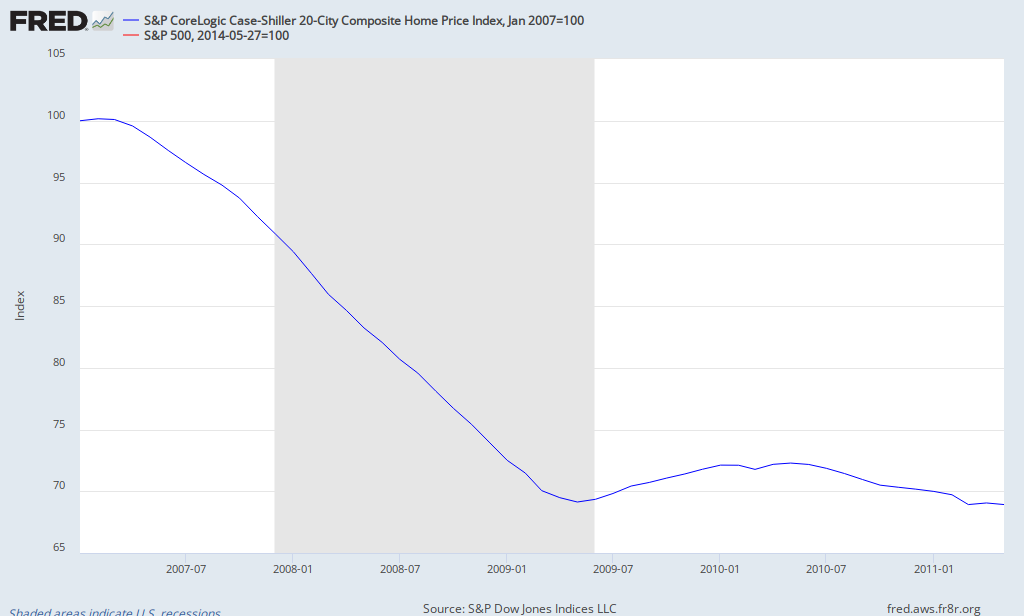
A fellow blogger has pointed out a comparable chart to yesterday's share price v house price chart for Australia since 2003 from the Federal Reserve Bank of St Louis.


Just because housing investors (in some Australian cities) have made relatively good returns over the past four years, that shouldn't be interpreted as an indication of future outcomes.  There are precedents for large sustained falls in home values which will be extremely financially painful for the leveraged investor.

Comments on the London riots


I have a mind that continually seeks answers, and have therefore had an interesting time looking for answers to the London riots. The question is - why are people rioting?

Clearly there was a legitimate protest last week about police violence and the shooting of a man. But why would that lead to people completely unrelated to the event participating in social media facilitated rioting and looting?

Last night’s 7.30 report had a good interview with a former UK police advisor who pinpointed a growing pool of disengaged citizens, perhaps from families with generational unemployment and council housing – a pool of people with nothing to lose who are attracted to the excitement of the riots and the opportunity to be part of something, since they have never themselves felt like part of society.  This seems a reasonable explanation to me, but doesn't really help explain what type of actions government might want to take in the future to help avoid the situation.

Tyler Cowen links to some academic studies on the economics of riots, noting the importance of opportunity cost, chance of punishment, ethnic and cultural diversity, but not of poverty.

Here are some reader comments from Bristol West’s Liberal Democrat MP Stephen Williams’ blog that I found had some interesting angles. (ht:Chris M)

  • The main thing to come out of this for me is how out of touch with today’s youth, and particularly the ‘lost’ youth, the government is. It’s not only the greed that caused this. It has as much to do with fun. These people were visibly enjoying themselves, it’s like heaven for them. Violence, hate and destruction are an intrinsic part of their lives. They love it, and the inability of anyone in power to understand why is why the problem will never go away.

  • It’s the way this round of civil unrest has a weird consumerist spirit that seems genuinely unusual. Reports of looters standing around deciding what shops to kick in based on what stuff they want; of kids trying on different pairs of trainers in a kicked-in JD Sports before picking which ones to take. Even while burning buildings, smashing cars and attacking police, the looters retain a well-disciplined sense of their need to make ‘wise’ consumer decisions, and remain obedient to market-based desires.

  • As usual an MP with no regard for considering who might be at the root of this unrest ie the bankers, politicians and big businesses who dont pay their taxes and make us all look like fools while they live in their Surrey mansions. How about, just for once, coming up with some policies that help people to make a contribution to their comminities instead of slashing jobs and services to pay for the failing of the banks. These people are angry,frustrated and have had enough of being told what to do by people whose only interest is serving themselves.

  • They are only out clashing with police and looting shops because they have nothing else to do, and nowhere else to go. The riots are caused by ruthless austerity measures that mean their voices are drowned out. It is hypocritical for you to blame them for starting these riots when it was really your coalition government. You say we “need to have a good hard look at the direction in which our society is heading.” Damn right we do. The way your government is going, this cry for help from the deprived may become a lot more common.

  • “A riot is the language of the unheard.” —Martin Luther King, Jr.

  • so 30 years of boardroom pay rises of 60-80% per annum, funded by “efficiency savings” i.e. sacking much of the work force, along with no wage rises for those at the bottom of the corporate structure “lucky” enough to still have their jobs – would have absolutely nothing to do with all this at all? i guess the sight of wealthy bankers ruining the economy and causing people to lose their jobs and homes being repossessed while they retire at 50 (sir fred goodwin) with £1million+ per year pensions is setting the right example? if the system is seen to be corrupt, greedy & there is no hope even given to those at the bottom, while they are constantly taunted by glamorous billboards advertising the latest “must haves” in a consumerist society, things they can never afford, who can be surprised when the first opportunity is taken, and any excuse will do, to just say sod it, and take what you can. god helps those who help themselves – just ask any burglar. and burglars are pretty much what the boardroom giants and bankers are. does sir philip green and other wealthy people even pay tax? i think not.

Thursday, August 4, 2011

Quick links and curious thoughts

Housing bubble – my favourite quote ““No one can produce an explanation as to how fundamental factors can lead to a run-up in home sale prices, but not rents” (originally from here)

ACCC says milk war is actually what competition is all about

Dumbed down debate -  
In 1860, in New York Abraham Lincoln began his campaign for the presidency with a very complex speech about slavery at the Cooper Union, 7500 words long, complex and nuanced. All four New York newspapers published the full text, which was sent by telegraph across the nation, widely read and discussed. In 1860 the technology was primitive but the ideas were profound and sophisticated. In 2011 technology is sophisticated but the ideas uttered by presidential aspirants are embarrassing in their banality, ignorance and naivety.

Dog whistle politics -   
JASON REIFLER: Well we're certainly susceptible to misinformation in that once we believe something that is wrong then it's really difficult to correct people.

ELEANOR HALL: So we know that our ignorance about certain issues makes it easy for us to be misled but your research shows that we don't necessarily change our minds even when we have the facts. 


I wonder about the geographical boundaries used for the capital city price indices. For example, the Brisbane City Council area would not include many homes that are in ‘greater Brisbane’, but not in the local government area. These areas include Moreton Bay Regional Council, Redlands and Ipswich (where a large portion of the new housing supply is located).  Different data providers using different areas would explain some of the inconsistencies in price movements detected. I would happy to hear some detail about this from the data providers.

(ht: okakesan)

An explanation of equality concerns about progressive tax systems (ht: Chris Boulis)
Suppose that every day, ten men go out for beer and the bill for all ten comes to $100...
If they paid their bill the way we pay our taxes, it would go something like this...

The first four men (the poorest) would pay nothing.
The fifth would pay $1.
The sixth would pay $3.
The seventh would pay $7..
The eighth would pay $12..
The ninth would pay $18.
The tenth man (the richest) would pay $59.
So, that's what they decided to do.

The ten men drank in the bar every day and seemed quite happy with the arrangement, until one day, the owner threw them a curve ball. "Since you are all such good customers," he said, "I'm going to reduce the cost of your daily beer by $20". Drinks for the ten men would now cost just $80.

The group still wanted to pay their bill the way we pay our taxes. So the first four men were unaffected. They would still drink for free. But what about the other six men ? How could they divide the $20 windfall so that everyone would get his fair share?

They realized that $20 divided by six is $3.33. But if they subtracted that from everybody's share, then the fifth man and the sixth man would each end up being paid to drink his beer.

So, the bar owner suggested that it would be fair to reduce each man's bill by a higher percentage the poorer he was, to follow the principle of the tax system they had been using, and he proceeded to work out the amounts he suggested that each should now pay.

And so the fifth man, like the first four, now paid nothing (100% saving).
The sixth now paid $2 instead of $3 (33% saving).
The seventh now paid $5 instead of $7 (28% saving).
The eighth now paid $9 instead of $12 (25% saving).
The ninth now paid $14 instead of $18 (22% saving).
The tenth now paid $49 instead of $59 (16% saving).

Each of the six was better off than before. And the first four continued to drink for free. But, once outside the bar, the men began to compare their savings.

"I only got a dollar out of the $20 saving," declared the sixth man. He pointed to the tenth man,"but he got $10!"

"Yeah, that's right," exclaimed the fifth man. "I only saved a dollar too. It's unfair that he got ten times more benefit than me!"

"That's true!" shouted the seventh man. "Why should he get $10 back, when I got only $2? The wealthy get all the breaks!"

"Wait a minute," yelled the first four men in unison, "we didn't get anything at all. This new tax system exploits the poor!"

The nine men surrounded the tenth and beat him up.

The next night the tenth man didn't show up for drinks, so the nine sat down and had their beers without him. But when it came time to pay the bill, they discovered something important. They didn't have enough money between all of them for even half of the bill!

And that, boys and girls, journalists and government ministers, is how our tax system works. The people who already pay the highest taxes will naturally get the most benefit from a tax reduction. Tax them too much, attack them for being wealthy, and they just may not show up anymore. In fact, they might start drinking overseas, where the atmosphere is somewhat friendlier.

David R. Kamerschen, Ph.D.
Professor of Economics.

For those who understand, no explanation is needed.
For those who do not understand, no explanation is possible.

Tuesday, July 19, 2011

Economic images

Sometimes I stumble across humourous images and quotes in which I instantly find a deeper meaning. Here are a few recent ones, and my accompanying thoughts.

The first I stumbled across at Bryan Kavanagh's blog (which is worth a read).
What makes it funny is that it is so close to the truth. To me, the deeper meaning is that we have lost an understanding with what real productivity actually is.

The next image can be found all over the web now, but to me provides insights into exactly how new technology integrates into society. 
While we can laugh that the publicly run enterprise is stuck with 1960s technology, to me it says much more. It shows that aggregating many new technologies (computing, flight control, materials etc) into one much larger and more ambitious technology (the space shuttle) takes a long time. Also, it shows me that there are lock-in effects. The car has not changed much at all. This is partly because roads and associated infrastructure are still much the same, and drivers are trained to use the same controls in the car itself. This limits scope for macro improvements in car transport. The same applies to the space shuttle.

I also stumbled across this quote -

As Douglas Adams wrote in 1999, "Anything that gets invented after you're thirty is against the natural order of things and the beginning of the end of civilisation as we know it until it's been around for about ten years when it gradually turns out to be alright really." Yes, the world is different now. Do try to keep up 

This is an important one to keep in the back of our minds when we imagine seeing society deteriorate before our eyes.  I recall that the ancient Greeks worried about the proliferation of written texts, because it meant people no longer needed to remember and recite long passages. Only if you could remember a passage word for word did it show you truly understood its meaning. 

Tuesday, July 12, 2011

Google economic indicators

I have mentioned Google’s real time price index before. Today I want to go ‘around the grounds’ to see how internet prices and search results are being used as economic indicators.

MIT is doing it with their Billion Prices Project. Their index appears to be very similar to Google’s and appears to track the official index in the US well, and a little advanced. That is promising.


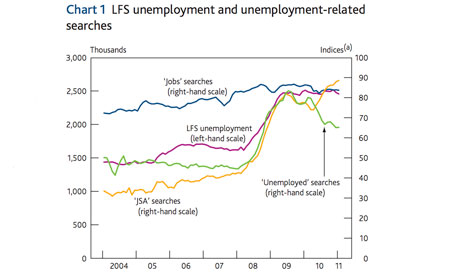
The Bank of England is using search term frequency as a complement to survey data to provide a better picture of the labour market. The chart below shows that quite a few search terms provide an indication of conditions in the labour market.


The Economist uses search term frequency to reveal concerns about the fragility of the Chinese economy. For some reason ‘hard landing’ as a search term is rapidly becoming more popular. (Hopefully this is not because of a new rock band by that name, otherwise that would be embarrassing.)


Economist bloggers are also very keen on the possibilities that Google search statistics present. Justin Wolfers tests some search terms over at the Freakonomics blog, while a local economic blogger finds a strong correlation between the unemployment rate and the search term ‘piercing pictures’. Yes, correlation does not imply causation.


And of course yours truly has used Google search terms to investigate whether Australians believe they are in a housing bubble, with reference to the trends in housing prices and Google searches in the US.


Lastly, the academic community is finding that search term frequency a useful tool as a proxy measure for real life frequency of events.

We propose, based on the premise that the occurrence of a phenomenon increases the likelihood that people write about it, that the relative frequency of documents discussing a phenomenon can be used to proxy for the corresponding occurrence-frequency. 

I feel like this is just the tip of the iceberg in terms of the power of the data being collected by Google.  And I hope that this valuable data continues to be provided for free to the general public.

Sunday, July 10, 2011

Thought bubbles


No borders?
Imagine there's no countries
It isn't hard to do 
Nothing to kill or die for

In the spirit of John Lennon, what would happen if all countries started a free worker mobility agreement? Where would people leave, and where would their destinations be? Would the world be better off on average? Would it solve many conflicts?

Population arguments
Land is an asset. As the industry would say, they aren’t making any more of it. But shares are also an asset, and most companies aren't make any more shares. So does population growth increase share prices as well? After all, there would be more people competing for the same number of shares?

More support for property – tax deductibility for public servants
Salary packaging mortgage payments seems like just another housing market subsidy available to public servants. A worked example here.

Mere monkeys?
Monkeys trained to use money for transactions (from here)

The essential idea was to give a monkey a dollar and see what it did with it. The currency Chen settled on was a silver disc, one inch in diameter, with a hole in the middle -- ''kind of like Chinese money,'' he says. It took several months of rudimentary repetition to teach the monkeys that these tokens were valuable as a means of exchange for a treat and would be similarly valuable the next day. Having gained that understanding, a capuchin would then be presented with 12 tokens on a tray and have to decide how many to surrender for, say, Jell-O cubes versus grapes. This first step allowed each capuchin to reveal its preferences and to grasp the concept of budgeting.

Then Chen introduced price shocks and wealth shocks. If, for instance, the price of Jell-O fell (two cubes instead of one per token), would the capuchin buy more Jell-O and fewer grapes? The capuchins responded rationally to tests like this -- that is, they responded the way most readers of The Times would respond. In economist-speak, the capuchins adhered to the rules of utility maximization and price theory: when the price of something falls, people tend to buy more of it....

During the chaos in the monkey cage, Chen saw something out of the corner of his eye that he would later try to play down but in his heart of hearts he knew to be true. What he witnessed was probably the first observed exchange of money for sex in the history of monkeykind. (Further proof that the monkeys truly understood money: the monkey who was paid for sex immediately traded the token in for a grape.)


Young property buyers making smart property decisions
Apparently, one in ten home buyers ‘rent to invest’. They choose to rent their principle place of residence, and invest in property elsewhere. This makes perfect sense, and I have commented before why this is always the best way to get financial exposure to the property market – far better than buying to occupy. It is what I’ve always done.

As I said 18 months ago -

What we learn from this exercise is that buying your own home in today's economy is far inferior to buying a home as an investment, or renting and staying out of the property market completely 

Carbon Tax to reduce effective marginal tax rates (must read analysis) 

People are terrible at objectively determining quality
In Washington , DC , at a Metro Station, on a cold January morning in 2007, this man (image above) with a violin played six Bach pieces. During that time, approximately 2,000 people went through the station, most of them on their way to work. After 45 minutes only 6 people had stopped and listened for a short while. About 20 gave money but continued to walk at their normal pace. The man collected a total of $32. When he finished playing no one noticed and no one applauded. There was no recognition at all.

No one knew this, but the violinist was Joshua Bell, one of the greatest musicians in the world. He played one of the most intricate pieces ever written, with a violin worth $3.5 million dollars. Two days before, Joshua Bell sold out a theater in Boston where the seats averaged $100 each to sit and listen to him play the same music.

Sunday, July 3, 2011

Cannon's Law


Cannon's Law says that if it will work, then the government won't do it. If regulation would really bite, the regulated parties will work the political system to kill it. (here)

With so many simple effective regulatory reforms that would greatly enhance economic efficiency being constantly overlooked, this spoof law resonates with my experiences. It is particularly relevant to the mining tax, the carbon tax, and other reforms currently being considered (even to the Greek debt situation).

The point is that economists often oversimplify policy matters. They consider government decisions is isolation of the interaction between affected parties and politicians. Remember, most policy changes involve winners and losers, and the relative political clout of each group can determine the actual outcomes.

My version of Cannon’s Law would be a little more subtle and say –

The more effective the regulation in achieving outcomes for the public good, the less likely the regulation will be appropriately implemented due to the increased likelihood of regulatory capture.

For those not familiar with regulatory capture, the following definition might be useful.

For public choice theorists, regulatory capture occurs because groups or individuals with a high-stakes interest in the outcome of policy or regulatory decisions can be expected to focus their resources and energies in attempting to gain the policy outcomes they prefer, while members of the public, each with only a tiny individual stake in the outcome, will ignore it altogether.[1] 

Regulatory capture refers to when this imbalance of focused resources devoted to a particular policy outcome is successful at "capturing" influence with the staff or commission members of the regulatory agency, so that the preferred policy outcomes of the special interest are implemented.

Regulatory capture does not have to involve intentional ‘ship jumping’ by agencies. The simple fact that you are spending a lot of time talking to the industry you regulate makes you identify with that industry.

For example, the agency who is charged with regulating the amount of water available to be used in each river system would talk with farmers quite a bit. They would begin to think that they are in the ‘water business’ rather than the ‘protect the public interest’ business, thus subtly shifting their subconscious focus.

To be clear, there are two key political realities that economists usually overlook.

1. If a new regulation will be very effective, it is unlikely to see the light of day; and
2. Even if a new regulation is adopted, it is likely to be watered down by vested interests ‘capturing’ the regulatory body.

In the end, perhaps our political leaders are not as powerful as we think. Our democracy appears to have a secondary feedback loop between politicians and interest groups that chugs along behind the main cycle of politicians reporting to the people at the ballot box. The power rests with the people and the alliances we form in business and social practices.

Perhaps the power is distributed unevenly due to the differences in wealth between groups.  And maybe there are simple ways around that, like capping and declaring political donations.  Or maybe this wealth difference is not so important - even big business needs to keep customers happy.

Maybe these thoughts are no surprise to you. But it is nice to lay it all out and ponder our own positions is this social game.

Tuesday, June 21, 2011

Go back to where you came from - Australia's talking

Last night SBS aired their new three part series Go Back To Where You Came From, where six Aussies take part in a 'reverse refugee' experience.

I think most viewers would agree that it was particularly interesting to watch the participant's reactions to meeting refugees and visiting detention centres.  Participants are from quite different backgrounds, and they have a variety of opinions on refugee policy.

The show apparently has twitter all a buzz, and is generating quite a deal of media commentary.  Much of the reaction focuses on the apparent ignorance of one particular participant to the real situation of refugees - especially in light of their strong opinions on the matter.

My wife suggested that there was a clear pattern in the participant's attitudes - those with broad travel experience seem to have more tolerant views.  It was telling that a couple of participants had never left Australia before the show.

What I found missing from the show, which would have been a nice complement to the emotional dimension, is reference to the actual statistics on refugees, their country of origin, the proportion coming by boat, and the changes in refugee numbers over time.

This is important because the public debate usually overlooks a couple of key points.

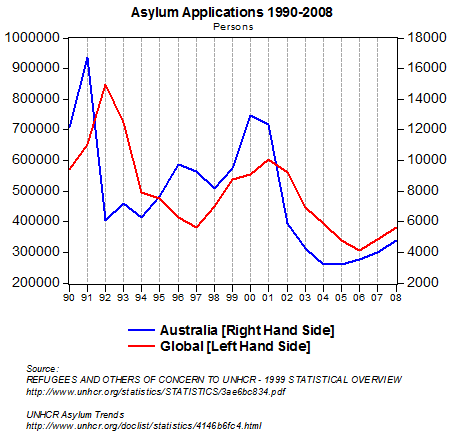
1. Boat people are a minority of asylum seekers and a tiny fraction of total immigration (graph below from here)

2. The number of asylum seeker arriving in Australia correlates strongly with global numbers, suggesting that it is not so much the policy of the destination country that influences the number of arrivals, but the situation in the country of origin (see the graph below).

For more detailed analysis of the factors involved in refugee outcomes, read this detailed article. I look forward to the follow up episodes tonight and tomorrow, and recommend the program to anyone even slightly interested in the topic.

Wednesday, June 15, 2011

The eurozone is saving Germany

Over at Business Spectator, Oliver Marc Hartwich has laid out the reasons Germany is so keen to maintain the currency union even though Greece is effectively living on German welfare. A low value euro gives German exporters a massive advantage, probably more benefit than the cost of supporting Greece.

I recommend going over to BS and reading in full, but below is the crux of the article (with my emphasis in bold).

These figures explain why German politicians fear nothing more than a break-up of the eurozone. Apart from the inevitable repercussions for the global financial system, any scenario in which weaker eurozone countries departed from monetary union – let alone a scenario in which Germany itself pulled out – would inevitably have an impact on Germany’s exchange rate. It would appreciate substantially and thus undermine its export-dependent economy upon which much of Germany’s recent economic performance is built. No wonder then that German politicians still prefer to pay for Greece, Portugal and other struggling countries, however grudgingly.

Unfortunately, the current German strategy to keep the eurozone together at all costs is extremely short-sighted. It leaves countries like Greece and Portugal permanently dependent on German transfer payments while burdening German taxpayers with enormous liabilities and risks. All of that for the dubious benefit of prolonging and amplifying existing trade imbalances within Europe.

When I pointed out to the advisor that the German government’s policies effectively turned Greece into one big welfare recipient, the answer I got was little more than a ‘Yes, that’s true, but we can still afford it’.

Tuesday, May 31, 2011

The telco confusopoly

The one frustration that started me blogging more than three years ago was the confusing pricing practices of phone and internet service providers. It was quite obvious to me that their 'plans' where meant to be confusing to ensure the consumer could not easily identify the cheapest provider. Today, the Australian Communications and Media Authority (ACMA) has released a report that recommends improving price information for telecommunications contracts to avoid a 'confusopoly' (here).  Amongst other things -

The authority also wants to prohibit what it says are misleading advertising practices, such as the use of the term "cap" on mobile and broadband plans.

"It's not a cap, it's not a maximum, it's a minimum," Mr Chapman said

"We want to prohibit that unless its a genuine hard cap, so that if you exceed your limit the service ends or you get the opportunity to upgrade." (here)

Most recently I have been comparing mobile phone plans. Some of the cheap plans don't allow you to call 13, 1300 and 1800 numbers under the cap, and they all have different call rates, flag fall and penalties for exceeding cap limits. To actually compare providers you need to know your calling needs in advance and have the mathematical skills to run this call profile, and other scenarios, through a model of each available phone plan. Insanity.

As I previously wrote -

By consciously manipulating these two criteria of a free market [low barriers to entry and perfect, or at least good, information], all firms in the market are able to avoid a state of true competition that would produce the most efficient allocation of services, and are able to artificially inflate the value of the commodity, hence producing more profit for each firm in the market.

This is not meant to sound like a conspiracy, because indeed each firm does not need to meet in back rooms with the other firms in the market and all agree to limit customer information and the comparability of their products. They each simply need to aspire to the great marketing ideal of product differentiation, a concept that is fundamentally designed to artificially eliminate direct competition by removing direct comparability.
...


The power of product differentiation, through its ability to remove comparability and create an information gap to distort what could be a perfectly competitive market, can be demonstrated by the case of the term life insurance market in the US in the late 1990s. There was a mysterious and dramatic drop in prices across all firms that did not correlate to price drops in other forms of insurance, which themselves where steadily rising.

According to economist Steven D. Levitt, this can be attributed to the realisation of a perfect market through the power of the internet. Although term life insurance policies had been quite homogeneous before this period of time, the process of shopping around for the cheapest price had been convoluted and time consuming, whereas websites such as Quotesmith.com suddenly made the process almost instantaneous.

In just a few years, the value of the term life insurance market in the US had dropped by USD$1bilion because of the new found ease of comparability. What insurance firm would want this to happen? Even if you were a small player in the market, say a 1% market share, your turnover had just dropped by $10million. It is perhaps one of the great recent examples of the power of perfect competition in allocating resources efficiently, yet possibly one of the greatest blunders by the insurance industry.

I believe that the power of private enterprise is its innovative response to the financial risks it incurs, but with very simple regulation the innovative confusopoly, which comes at a cost to cosumers, can easily be avoided.  Indeed, most of the pushback against the telco confusopoly is from webpages which keep up-to-date tabs on plans from each service provider and enable you to take some rough guesses about future use and compare the cost effectiveness of each offering (eg here)

Wednesday, April 13, 2011

If this doesn't blow your mind...

I stumbled across this video on the web.  It's about growing organs... from scratch.  Absolutely amazing! 12 minutes very well spent.

Tuesday, April 12, 2011

Risk homeostasis, Munich Taxi-cabs and the Nanny State


There is an odd coexistence between two conflicting safety policies that may well be pursued by the same accident prevention agency. The first seeks to improve safety by alleviating the consequences of risky behaviour. It may take the form of seat belt installation and wearing, airbags, crashworthy vehicle design, or forgiving roads (collapsible lamp posts and barriers). This policy offers forgiveness for a moment of inattention or carelessness. The second policy seeks to improve safety by making the consequences of imprudent behaviour more severe and includes things such as speed bumps, narrow street passages, and fines for violations. Here, people are threatened into adopting a safe behaviour; a moment of inattention or carelessness may have a dire outcome. 

While these two policies seem logically contradictory, neither is likely to reduce the injury rate, because people adapt their behaviour to changes in environmental conditions. Both theory and data indicate that safety and lifestyle dependent health is unlikely to improve unless the amount of risk people are willing to take is reduced. (here - my emphasis) 

The above passage points out a common logical absurdity, and contains an important lesson for Australian’s with and overeager obsession of controlling personal choices through ‘nanny state’ regulations. More on the nanny state a little later. 

First, it is important to examine the hypothesis of risk homeostasis to properly understand the implication of the opening quote, since it claims that neither of the two contradictory policies aimed towards improving safety are effective. 

The essential argument of risk homeostasis is that humans have an inbuilt level or risk that they gravitate towards in response to their external environment. If we reduce the risk of an activity, people will compensate by finding other risky activities as a replacement, or undertaking the activity in a more extreme manner. For example, if we ban smoking tobacco, which doesn’t seem like such a remote possibility, do we really expect smokers to replace their habit with fruit snacks and yoga? Or might they compensate by increasing their alcohol consumption or perhaps smoking dope instead. 

Risk homeostasis is not to be confused with risk compensation, which suggests that individuals will behave less cautiously in situations where they feel "safer" or more protected, but that we don’t necessary return to a predetermined risk equilibrium point. 

Improving transport safety is an area where there is strong evidence risk compensation, and indeed of risk homeostasis. 
One reason I am against mandatory bicycle helmets is due to the increased dangers posed by this perception of safety. Not only do cyclists tend to behave more aggressively, but helmet wearing changes the behaviour of other road users. It decreases the rate of cycling, and the effect of fewer cyclists on the road is to increase the danger of the remaining cyclist, but it also makes vehicle drivers act more carelessly around cyclists. 

This study fitted a number of bicycles with video cameras and ultrasonic sensors to detect the proximity of vehicles as they passed cyclists on the road. They found that vehicles passed helmeted riders about 8.5cm closer than cyclists without helmets. The suggestion is that drivers perceive there is less risk from clipping a helmeted rider and that helmeted riders are more experienced and unlikely to ride erratically. They also found driver give female cyclists much more room! 

Of course this behaviour is all based on perceptions. Helmets themselves provide minimal protection in a limited number of head collisions, and can exacerbate brain injury for some other types of collisions where helmets can increase rotational acceleration during a collision. 

The best experimental evidence of risk homeostasis is the famous Munich Taxi-cab experiment, where for three years half the taxi cabs in a fleet had ABS brakes and the other half didn’t, and various monitoring and testing took place including fitting all vehicles with accelerometers. 

Among a total of 747 accidents incurred by the company's taxis during that period, the involvement rate of the ABS vehicles was not lower, but slightly higher, although not significantly so in a statistical sense. These vehicles were somewhat under-represented in the sub-category of accidents in which the cab driver was judged to be culpable, but clearly over-represented in accidents in which the driver was not at fault. Accident severity was independent of the presence or absence of ABS.
...
Subsequent analysis of the rating scales showed that drivers of cabs with ABS made sharper turns in curves, were less accurate in their lane-holding behaviour, proceeded at a shorter forward sight distance, made more poorly adjusted merging manoeuvres and created more "traffic conflicts". This is a technical term for a situation in which one or more traffic participants have to take swift action to avoid a collision with another road user. Finally, as compared with the non-ABS cabs, the ABS cabs were driven faster at one of the four measuring points along the route. All these differences were significant. 

To put this experiment in the context of our original two options for reducing risk, ABS brakes are an example of an action that reduces the consequences of risky behaviour. Hence such actions decrease total risk. 

But the study did not end there, and finds some evidence that the opposite type of strategy, increasing the consequences of risk taking, has quite an effect. 

In a further extension of their study, the researchers analysed the accidents recorded by the same taxi company during an additional year. No difference in accident or severity rate between ABS and non-ABS vehicles was observed, but ABS taxis had more accidents under slippery driving conditions than the comparison vehicles. A major drop, however, in the overall accident rate occurred in the fourth year as compared with the earlier three-year period. The researchers attributed this to the fact that the taxi company, in an effort to reduce the accident rate, had made the drivers responsible for paying part of the costs of vehicle repairs, and threatened them with dismissal if they accumulated a particularly bad accident record. 

My favourite example of different effects of increasing consequences of risk taking versus decreasing the consequences is here. 

Sometimes, students would deny that they drive more recklessly when wearing a seatbelt. Tullock liked to illustrate the idea of offsetting behaviour for them by asking what they'd do if a large spike extended from the steering wheel and pointed directly at their heart. Wearing a seatbelt is a mild form of that effect, but in reverse. Tullock's students came to call the thing the "Tullock Spike". 

Australian policy makers could learn some lessons from risk homeostasis. For any returning Aussie from time abroad the degree of over-regulation can be a shock. One friend recently returned from three years in Paris and said that it was the one thing that enraged them the most about coming home. 

Think about it. We can’t buy alcohol at the supermarket, nor drink it in a public place, nor smoke in a building even if the owner is trying to run a cigar smoking cafe. In fact the body corporate of an apartment building recently passed a by-law to stop people smoking in their own homes! 

With the recent surge in anti-smoking opinion, not only will smokers pay ridiculous taxes, cigarette producers will need to adorn their prized products with pictures of diseased organs, but not their own brand label. Luckily, alcohol is exempt from such measures which might make the Chinese communist party blush, yet arguable alcohol is a far greater public health concern. 

We can’t buy fireworks or ride without a helmet. There are now calls to ban topless bathing on NSW beaches and there is the infamous internet filter proposed my communications minister Conroy. Oh, I almost forgot the proposal to ban teachers from using red pens when marking because red is an aggressive colour!

We can’t be expected to navigate construction zones on the street without 17 different warning signs, stop-go lollipop ladies, flashing lights and orange fencing, nor, it seems, are we expected to navigate over treacherous cracks in footpaths, with councils often paying compensation to ‘victims’ of such treachery. We have the slowest speed limits yet many would say the worst drivers. 

Policy makers must believe the average Australian has both multiple personality disorder and signs of schizophrenia. Someone who can perfectly judge their own financial risk when taking on massive debt, can choose their own career, raise their own children, run their own businesses and judge the associated risks, yet when it comes to the basics of life, like having a beer, tanning your breasts, or navigating the street, we all become complete morons incapable of rational behaviour. 

I have no problems with governments intervening to protect people for the actions of others, but they should be make their own choices about their personal safety. The strongest argument in favour of this position is the theory of risk homeostasis. It seems we really can’t save people from themselves. In fact the parent in me suggests that all this molly-coddling decreases our ability to judge real risks when they arise.  

Rant over.