Life expectancy has peaked in some US States according to recent research. This follows research published in 2005 that suggests current living children may not outlive their parents, and that peak life expectancy in the US may be reached between 2030 and 2040. Mostly, this is attributed to the massive spike in childhood obesity which typically results in lifelong obesity and associated health problems.
In coming decades, as obese children carry their elevated risks of death and disease into older age, average life spans could fall by two to five years.
The map below shows areas of the US where life expectancy fell between 1987 and 2007 (in red). At first glance it seems that rural areas are overrepresented in falling life expectancy. There is usually is typically a strong inverse correlation between obesity and income, which would appear consistent, but also one could guess that more automation of rural jobs, and greater propensity of sedentary recreation activities (the internet etc), may be a contributing factor.
Since then more evidence of decreasing life expectancy is dripping into the debate, especially in the US. One recent study suggests that based on data from 2008, the latest available, life expectancy in the U.S. fell 36.5 days from 2007 to 77.8 years.
But the overall picture still looks very good. The below graph compares the growth in life expectancy in a selection of countries.
In Australia, life expectancy continues to grow, but there appears to be no similar geographical disaggregation studies showing the divergence between urban and rural life expectancy. The data below shows that men have gained 3.1 year of life expectancy at birth in the past decade, while women have gained 2.1 years
For me, the surprising thing in these data tables is that our life expectancy at birth is rising mostly due to the prevention death earlier in life, not the extension of life after 85. If you make it that far, you have only gained six months of extra life expectancy over the decade – around a quarter of what you gained at birth (one fifth for men).
The other trend of note is that men are catching up to women in the life expectancy at birth. Again, this concurs with the observation that early preventable deaths are being reduced, as risk taking behaviour is disproportionally male.
A couple of questions spring to mind. First, will the rising trend in life expectance continue in the rest of the world? And second, the big question is whether there is a biological limit to life expectancy that developed countries are trending towards, to whether peoples lifestyles are compensating for improved medical care by being less vigilant about their health or taking more health risks?
When I watch extreme sports I often think that it could be a sign that we as a society have made life so risk free that people need to compensate by taking on risky activities. I would classify this type of risk as low probability but high impact, and it is the type of risk we seem to regulate tightly, with seatbelts, helmets, fire alarms and other safety precautions.
My interpretation is that as a society we have removed many high impact low probability risks, but compensated them to a small degree. This compensation must be small, as the data show that the prevention of death early in life the key reason for increased life expectancy at birth.
The other type of risk, high probability but low, or distant, impact is what we usually don’t address well. Smoking laws in Australia are probably the stand out success in this area. But when we do address them, they are the easiest risks to substitute for others. For example, a former smoker might find that chomping down a bit of chocolate is a good substitute for their addictive habit.
Further, we might be avoiding high impact risks by substituting for low impact risks. Parents need to be especially aware of this. For example, cycling appears to be dangerous because of the need to wear helmets, so parent might be less inclined to encourage cycling. The same goes with sports where there is a perception of high risk, such as rugby or Aussie rules football. Even the most basic of actions such as walking to school is often seen through the high risk lens (due to the low probability of abduction) and a generation used to being dropped at the gate may be less likely to walk later in life.
I have no definitive answer to either question. My gut feeling is that medical breakthroughs will stay one step ahead of any compensatory behaviour, and that life expectancy will creep up ever so slowly. I also feel that life expectancies between countries will continue to converge. But I will be on the lookout for more evidence of a peak in life expectancy elsewhere, and should we see this case arising more frequently, I believe that the theory of compensatory behaviour will need serious investigation.
Showing posts with label Population growth. Show all posts
Sunday, August 7, 2011
Monday, November 15, 2010
Updates and a CityCycle apology
Plastic bag banning continues to gain momentum
And just for fun, a hilarious rap battle between Keynes and Hayek to entertain the inner economics nerd.
Well known demographer Bernard Salt had a stoush with Dick Smith in a little documentary a few months ago discussing Australia’s population growth. Now he is back with more nonsense.
Brisbane’s CityCycle scheme, from my observations, appears to be well used. I was pessimistic about the potential take-up rate of the scheme, but in the past six weeks of operation I have seen 27 people using these bikes – about 26 more than I expected. I do however live across the road from one station, work in a building adjacent to a station, and cycle past another half dozen twice per day.
Interestingly, I have seen one person using the scheme helmetless and smoking while talking on a mobile phone (I don’t have a problem with this if they are not riding dangerously, which they weren’t), and one bloke walk up to the bikes in work attire and promptly retrieve a helmet from his backpack before shooting off on a hire bike. I can only hope that with more (are there more cyclist, or just people deciding to use the scheme to avoid bike theft and wear and tear?) cyclists there will be a strong push for more user-friendly bike lanes.
Wednesday, October 20, 2010
No limits to economic growth
For an environmental economist these words are blasphemous, but I said them, and I have good reason to.
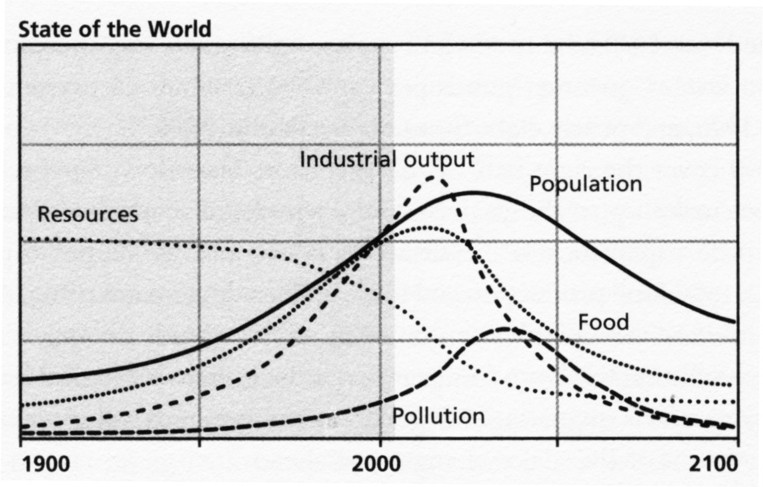
The modern Limits to Growth movement gained prominence with the publication of the Club of Rome’s book of the same name in 1972. This book, by Donella Meadows and colleagues, reports on the results of a computer simulation of the economy under the assumptions of finite resources. The World3 computer model produced scenarios showing that under various assumptions, a decline in non-renewable resources will lead to a decline in global food and industrial production, which will in turn lead to a decline in population and greatly reduced living standards for all.
The following image is one example of the results of their simulations where a catastrophic decline in industrial output, food production and population will result form reaching our finite resource limits.
While I don’t doubt the finitude of many natural resources, and that the human population cannot grow indefinitely, I doubt that finite limits of resource inputs to the economy necessarily means that economic growth cannot continue indefinitely.
To be sure, I am certain that substantial unforeseen changes to the rate of extraction of some resources will lead to short-term disruption of established production chains, such as shocks to oil supply, but in the long run I see no reason that an economy with finite resource inputs cannot increase production through improved technology and efficiency.
I need to be clear that when I talk of economic growth I mean our ability to produce more goods and services that we value for a given input. Increasing the size of the economy by simply having more people, each producing the same quantity of goods, will be measured as growth in GDP, but provides no improvement in the material well being of society.
A better measure of growth is real GDP per capita. This adjusts for the disconnection between the supply of money and the production of goods, and adjusts for the increase in scale provided by the extra labour inputs. Even then, this may overestimate the rate of real growth occurring, as there has been a trend of formalising much of the informal economy, for example child care, which is now a measured part of GDP rather than existing as individual family arrangements.
On these adjusted measures economic growth is a very slow process. In a world where non-renewable resource inputs are fixed or declining, it is the rate of the decline and the speed of adjustment that will determine the overall outcome for our well being. If the rate of decline of non-renewable resource inputs is below the rate of real growth (our ability to produce more with less) and the rate at which we can substitute to renewable alternatives, we can avoid economic calamity in the face of natural limits.
Unfortunately there are other factors at play.
The rate of population growth will greatly determine the per capita wellbeing in a time of limited growth. While extra labour input will no doubt contribute to production inputs, my suggestion is that this input will be outweighed by a decline in complementary resource inputs. Remember, we care about real economic ‘wealth’ per capita, and with more people there is a smaller share of remaining resources each person can utilise in production, thus reducing wellbeing.
Further, we can begin to take productivity gains as leisure time instead of more work time, thus there is a possibility of maintaining a given level of production in the economy with fewer labour inputs over time.
There is also the reliance of our financial system on high levels of growth. Many economic growth critics cite the need for exponential growth of financial measures of the economy as being in conflict with any finite system. Yet the ‘system’ itself is a human construction and I seen no reason why a stable money supply cannot operate under various levels of growth (even prolonged negative growth) if used cautiously and with little leverage.
Often forgotten is that many resources are currently fixed and yet go unnoticed. There are always 24 hours in a day, but that doesn’t stop us producing more each day. If a shortage of hours was encountered, would a sudden change to 23hrs (a 4% decline) have a dramatic impact? Or would society easily adjust to this new environment of tighter time scarcity?
While a smooth transition to prosperity under much greater limits on resource inputs to the economy is theoretically possible, I don’t expect this to be our future reality. Self interested governments, businesses and the general public will react to short term shocks in unexpected ways, potentially promoting conflict, and taking the bumpy road. I have no doubt that there will extended periods of prosperity in the future, but also expect a rough ride to get to them.
Tuesday, August 24, 2010
What does it mean for an economy to ‘turn Japanese’ and what determines whether it will?
What few seem to appreciate, either inside or outside of Japan, is just how strong the resulting Japanese recovery from 2002-2008 was. It was the longest unbroken recovery of Japan’s postwar history, and, while not as strong as pre-bubble Japanese performance, was in fact stronger than the growth in comparable economies even when fuelled by their own bubbles.
How on Earth did Japan manage that with their ageing population and zero population growth? Indeed, Japan outperformed Australia in productivity growth since 2000 and very nearly kept pace with real GDP per capita growth.
The RBA’s Ric Battelino seems confused. In a recent speech on the Australian economy he notes that “the slowdown in productivity growth has meant that GDP growth in the latest decade was not as fast as in the previous decade”, while also saying that for the past two decades “part of the growth came, of course, from the fact that the population grew strongly over the period, particularly in recent years.” What? The data he presents shows a negative correlation between economic growth and population growth, yet he continues to promote a positive relationship.
Australia’s average annual real growth in GDP per capita (currently the best measure of economic performance) since 2000 is 1.28%. While I can’t find a direct measure from the Japanese Statistical agency, using the World Bank data collection I can make a comparison of real GDP growth per capita of Australia and Japan using a common methodology. Using these statistics I find that Australia had a mean annual growth in real GDP per person since 2000 of 1.8% while Japan’s was 1.4%.
Notice in the graph however that Australia’s growth in real GDP per capita fell considerable from 2004, when population growth rates began to push up from 1.2% to a peak of 2.16% in 2008. Since 2002, when Japan’s real growth per person increased, the population growth rate declined from 0.2% the preceding 2 years to near zero (average 2003-2008 is -0.002%) till the financial crisis hit at the end of 2007.
Like Australian situation I described in a previous post, per capita growth appears to be compromised by higher rates of population growth in this sample of data.
Australia’s economic performance is terms of productivity growth looks pitiful in comparison to Japan. Average annual Total Factor Productivity growth since 2000 was a shy 0.47% (including a productivity recession in 2004-05) while Japan recorded a strong 1.77% over the same period (data from OECD here).
Of course there is always unemployment to consider. The graph below shows that on this measure, Australia is also behind Japan (having been in front for just the period 2007-2008). Some longitudinal data is here.
Recent research also suggests that Japan’s economic track record was unfairly blemished by asset price deflation followed by short recessions in the 1990s (1993, 1997 and 1998). The graph below (from here - including 20yr data set), shows Japan’s solid performance over the past decade, with their longest boom since WWII occurring from 2002-2008.
It appears that turning Japanese is not the tragedy it is made out to be by popular economic commentators. Here’s just one example:
As it turned out, Japanese investors lost nominal wealth equal to three entire years' GDP. And the economy today hasn't grown in 17 years or created a single new job.
Nor has the debt been reduced. Instead of permitting the private sector to destroy and pay off its debt, the public sector fought against it...borrowing heavily to try to bring about a recovery. Result: no recovery...and almost exactly the same amount of debt. But while the private sector paid off its debt, the public sector picked up the borrowing. Now it's the government that owes money all over town.
Detractors cite the massive and growing public debt in Japan as a problem, but if denominated in Yen, and with interest rates set at near zero, there is no burden from the debt. In fact, the Modern Monetary theorists would claim public debt in its own currency is never a burden because the government can print money to pay it down. (Maybe the Japanese government prescribes to this theory and keeps the debt as a record of past spending.)
The above graph confirms that Japanese government debt has replaced a substantial portion of private debt since the early 1990s. In my view this is a justified effort to keep the value of the yen stable by maintaining money in circulation - an approach that could be adopted in Australia in the coming decade, with government debt replacing household debt for the same reason.
One must keep in mind that it is probably not the intention of the Japanese government to ever pay off this debt. I am sure they are happy to continue to progress with a high savings rate, high productivity, high GDP, net exports and almost every other fundamental ingredient for economic success. Turning Japanese appears to be about more fundamental economic prosperity cradled in an unfamiliar monetary framework.
Thursday, August 12, 2010
Last piece of the population puzzle
I was pleasantly surprised by Dick Smith’s Population Puzzle documentary last night. He covered most of the key economic arguments against growth, including a rebuttal of the skills shortage and age dependency arguments. I was not taken by the food security argument, but was impressed by the way he highlighted the clash over land use on the urban fringes (where some of the most fertile soils are found).
Most importantly Dick raised the issue of vested interests promoting population growth early in his piece. He rightly singled out the property development lobby as a key exponent of higher population growth, and their obvious vested interests which do not align with the interests of most Australians.
Page 58 of today’s Financial Review has run a pro-population growth response to the Dick Smith documentary, advocating population growth on the grounds of economies of scale – an argument that is easily debunked.
A second argument appeals to economies of scale and suggests that with greater domestic consumption industries can expand to a point where they have economies of scale that make them internationally competitive. Why domestic population is currently a barrier to industry development is beyond me. If there are no artificial constraints on trade, shouldn’t the world be the marketplace of any industry even in its infancy? This argument only works if you couple high population with protectionism.
Economies of scale from increasing the size of the market only apply to monopolies in any case, and even then it is hard to know whether futher efficiency gains are possible (and whether they would be passed on to consumers).
But the confusion of the pro-population growth position is revealed later in the article when it states:
Of course it is possible to have economic growth without population growth – by setting up the conditions for higher productivity growth.
But the ‘meeting the challenges of growth’ argument persists in the end. We are apparently better off investing in massive duplication of infrastructure (roads, housing, energy and water) to accommodate higher population growth, which decreases productivity and economic growth, rather than focus on improving the productivity of the existing population - an absurd conclusion.
I have explained in detail in a previous post how housing investment and other infrastructure duplication does not improve productivity – it is a short term cost that simply allows more people to be equally as productive as the current population at some time in the future. Slower population growth is the recipe for improved per capita well being.
The relationship between growth and productivity is interlinked, but not in the way pro-population growth advocates maintain. Higher population growth is strongly negatively correlated with improved productivity. The graph below uses the ABS multifactor productivity measure and percentage change in population growth to demonstrate. Productivity improved most dramatically when population growth was around 1%.
The investment duplication argument is the final piece to the population puzzle.
Tuesday, August 10, 2010
Population problem? It’s called longevity
Population growth advocates often rely on the ‘age dependency ratio’ as their core economic argument. This ratio is the population aged over 65 divided by the population aged 15-64. To give this measure meaning there is an assumption that people will not work beyond age 65 and will therefore be need to be financially supported by those at a working age. Workers will get less of the return on their productive output because it needs to be shared with more non-workers. Essentially, the percentage of people in the formal economy will decline.
I have a different opinion on the age dependency ratio. I see it as a shining beacon of success. People are working for shorter periods of their life. We as a group are finally taking some of our productivity gains of the past half-century in the form of leisure time.
Whether or not you agree this a problem, the suggested solution of population growth is, in reality, counterproductive, and will only aggravate the situation. An increase in the dependency ratio is principally caused by improving longevity. If each generation lives longer than the last we will face this problem even with a growing population. Simply adding more at the bottom of the population pyramid to keep it bigger than the top has the apt label ‘population Ponzi scheme’. Indeed, to counteract this trend would require a significant increase in the natural birth rate, or age biased migration policies, or even the extreme scenario of sending migrants back home when they hit 65. None of these are desirable.
Australia’s age dependency ratio is 16th out of this comparison of 20 developed nations; none of whom appear to be in a hurry to stimulate population growth to ‘solve’ this problem. Sweden, Norway, UK, USA, Denmark, Germany and Canada all appear to cope quite well with their demographic fortunes. Our culture, financial structures and welfare system, are still adapting to a population pyramid becoming more cylindrical.
Notably, on one side of the debate are the vested business interests. Businesses which face demand limits per person (a single person can only consume one of the same newspaper per day) and are limited to domestic consumption (which foreigners are interested in Australian newspapers) have the most to gain from population growth. The other side includes a fair swag of the rest of us, including Dick Smith, who will be a guest in many living rooms Thursday night when he airs his anti-population growth documentary.
Overcoming the apparent economic strain of age dependency issue is extremely straightforward. People need to save during their productive years to be self supporting during their retirement years. Isn’t that the point of superannuation? This dissaving during retirement also shifts wealth to the next generation.
There are a number of other factors at play which are consistently overlooked in the age dependency argument.
- People will work longer. Seventy will be the new sixty. A gentleman I used to work for is 65 this year and is looking to acquire new skills for the next phase of his career.
- People will spread their work time over the life much better, possibly taking intermittent retirements between careers. They will probably work part time and casually long after 65.
- The participation rate may improve
- Productivity of the workforce will improve
- The population aged under 15, who are also dependent, will shrink
- Have the population minister put forward a stable population by 2030 as a goal for Australia
- Encourage older people still dependent on welfare into casual/part time work. This can be achieved by allowing up to, say, $15,000 to be earned before they lose any pension payment
- Remove the baby bonus
- Possibly phase in a reactive immigration quota based on last year’s population change to meet the target set in point 1
- Allow proceeds from the sale of a principle place of residence for those above 65 to be exempt from affecting social security allowances for a fixed time period – maybe 5 years. This encourages financial independence in the long run.
- Incrementally increase the pension age starting at a future point. In Germany it is now 69. We could make it say 66 on 2014, 67 in 2017, 68 in 2020, 69 in 2023, 70 in 2024.
Tuesday, July 13, 2010
Skilled labour immigration removes incentives for Australians to invest in education
The shrill from commentators warning of Australia’s apparent skills shortage is deafening. But there are a number of reasons why this claim, and the inevitable recommendation for government to increase quotas of skilled migrants, is flawed, and why the solution is not in the best interests of Australia in the long run.
For the acute observer the transparent falsehood of the claim jumps right out at you.
… skilled labour in an area like project construction is an international problem, so poaching what we need from overseas is not going to be easy.
ACIL Tasman points out that LNG project specialist workers are globally mobile, moving from site to site (and often between projects at varying stages of development) – wherever their services command the highest price. As the consultants warn, opting for less-experienced personnel carries with it the dangers of higher error rates in construction and resulting delivery delays and still more expense.
Translation: if you want the skills you need to pay.
A government with backbone, and an eye on long term prosperity, would tell industries crying poor to sort it out themselves. Large mining and gas projects have very long lead times - long enough in fact to train some of the existing workforce in skills that may be required for future projects. If you need the slam-dunk of skills and experience, you are inevitably poaching people from another project - experience only comes from a finite number of places.
LNG project specialists, discussed in the linked text above, can only develop specialised skills and knowledge of LNG projects by actually working on LNG projects. A company aware that the industry is expanding rapidly would be wise to have succession plans and internal training programs in place to plan for this highly predictable competition for workers.
Domestic companies have numerous options available to ensure adequate skills are brought to a project, but costs are kept to a minimum. Labour efficiency could be improved through improved task delegation for example. Administrative tasks can be time consuming, and an administrative assistant could be shared amongst a few technical people to greatly improve their productivity. Other technical innovations may also be possible in addition to the paying more to attract Australian workers back from abroad.
What is most bizarre about most of the skills shortage claims is that there is never a mention of salaries. In claiming any shortage in a market economy, neglecting prices will undermine your analysis. Furthermore, a recent study suggests that immigration itself can accentuate the problem:
LESS than a third of people from non-English speaking countries who migrate to Australia on skilled workers' visas are gaining work in their fields and many of them are adding to the skills crisis they were brought in to solve
Government intervening to increase immigration quotas of skilled workers results a number of problems. First, governments inevitably pick winners and losers. The industry that lobbies hardest to get their skills on the list can expand without having the added cost of paying their technical people higher salaries. It also raises the question of why we should limit immigration quotas to highly skilled people. Wouldn’t letting anyone through the door keep the wages of unskilled people down as well? Wouldn’t that also keep inflation down, and interest rates low? At least that’s the argument of one infamous spruiker.
Second, and in my mind more important for the long run, people who invest the time, effort and money to acquire skills need a return on that investment. Why would I spend over $100,000 and seven years of my life studying to be a doctor when I will end up earning the same as a plumber? Not until I have invested more than ten years of training into a specialisation will I end up charging a premium for my time. Acknowledging the importance of this return to education highlights a key feature in labour markets relevant to this debate.
Part of the return on education investment for Australians is the opportunity it creates for working abroad and earning a much higher salary. Doctors can easily be attracted to work in the US or the UK or for those with linguistic skills, continental Europe. The same applies for doctors and engineers from India and South East Asia. Their investments in education have opened the door for them to come to Australia. Put simply, skills in demand get raided by countries that can offer better pay and quality of life. Australia is a middleman in a global game (and our departures statistics confirm this - apologies for the age of this data).
This global competition for skills is no secret. A 2004 Senate inquiry into the ‘brain drain’ was commissioned in order to understand the problem better.
Many of these expatriate Australians are young, well-educated, highly skilled, and keen to see the world and to make the most of the opportunities presented to them. This has led many to fear that Australia is experiencing a ’brain drain’ of its best and brightest workers, with damaging consequences for Australia’s economy and society.
A key finding of this research was that Australia is in fact experiencing a ‘brain gain’ – more highly skilled workers were arriving rather than departing. Unfortunately, this simply supports the argument that returns on education for Australians are far greater if they move abroad, and that our skilled migration system is providing returns for those educated in less developed countries. If we continue to perpetuate this shuffling of skills around the globe, Australia will always struggle for skills and may become completely reliant on imported skilled labour.
We do have an advantage though. Educational services are one of Australia’s biggest export industries. Our universities are full to the brim, but not with local students keen to pursue careers in Australia. Foreign students and those looking for returns on the education investment abroad are becoming more common – the incentives are stacked in their favour. We need to attract domestic students and then keep them here to retain and grow our skills base in the long run.
Allowing more skilled migration will keep the wages premium low, and further remove incentives for domestic students to invest in these skills. Decreasing skilled migration will force business to place a wage premium of those skills it values most highly, which will in turn attract students to these professions.
While this is quite clearly a chicken and egg problem (did we need to attract skills because skilled Australians were leaving, or did they leave because we imported so many skills and decreased their domestic returns to education), a government, if it had the will and the backbone, could incrementally step back skilled migration quotas and other sponsorship arrangements, thus forcing salaries higher and temping some of these Australians home, and many more into our universities.
As a member of this group of relatively young and highly skilled professionals I can attest to the growing numbers attracted overseas by high salaries and fashionable lifestyles. There are apparently more than one million Australians living abroad, and a large proportion of them have taken the skills they acquired at home on the road. Because of the higher salaries, having skills in demand can offer a far better lifestyle even in the most expensive cities in the world. My network of friends and family here in Brisbane is diminishing by the month as the world tempts them away – will I be next?
Remember, well being is not about how much business is in your country, or how quickly you can dig things out of the ground. Well being is reflected at the level of the individual. One key aspect to this the real wage, or how much stuff you can buy with an hours work time. In the long run this key measure will improve if we can train and retain highly skilled people who will be driver of future productivity improvements. In the short run, businesses will need to adjust their operating structures to more effectively utilise these necessary skills as their wage premium grows. Immigration is not the problem here, but twisting the composition of new Australians in favour of those already possessing skills simply exacerbates the ‘brain drain’ and reinforces a reliance on imported skills.
Sunday, April 11, 2010
Economic arguments against population growth
While Population Minister Tony Burke may be new to the debate, the population debate itself is certainly not new to politics. In 1994 the Commonwealth commissioned an inquiry (the Jones inquiry) into Australia’s population and carrying capacity, yet the inquiry failed to make firm recommendations. One of the inquiry’s authors then wrote a book in protest of the ‘government’s timidity’ and concluded that “that a sensible population policy for Australia would be to aim at stabilising the population within a generation or so and that this was quite feasible if net immigration of something below about 50 000 a year (say 100 000 migrants in gross terms) could be maintained. Population would then more-or-less stabilise somewhere between 19 and 23 million (depending on actual immigration) sometime before 2050.”
Now, Tony Burke is faced with twin challenges of developing a policy position on population that keeps enough people happy to keep him in government.
We can easily run through some of the options available to Minister Burke – stimulate or dampen population growth. I suspect he would also like to encourage migration away from capital cities due to the ‘obvious housing shortage’, but as far as I can tell the Federal Government has little power to influence such regional migration (maybe an income tax relaxation depending on how remote your residence?)
To stimulate growth we could increase migration intake, and encourage higher birth rates – maybe $15,000 per child would do it? Or Burke could moderate population growth by reducing immigration quotas and discouraging high birth rates (by removing the baby bonus or even having a ‘child tax’).
But which option is best for Australia? Are there strong economic arguments in favour of either higher or lower population growth? I would argue that on balance, economic principles strongly favour a declining rate of population growth (even a negative rate of population growth not a problem).
For a start, we need to discredit some of the nonsense economics floating around. Bigger is not better. China and India both have plenty of people, while countries with the highest per capita incomes and standards of living generally have fewer people. China has greatly reduced population growth with its one child policy and seen vast economic growth – shouldn’t China have failed to grow because its population stabilised? The map above shows a pretty clear inverse relationship between population growth rates and standards of living.
Nor is a comparison of population density meaningful in this debate, or we could argue that any region with a low population density is ‘underpopulated’ (like Antarctica or the Simpson desert) because we have compared the region to Hong Kong or the Netherlands.
One core economic argument in favour of a greater population is that utility theory suggests that a trillion people living in poverty and slavery are better that one million happy and fulfilled people, leading lives directed by their own desires. It is known as the repugnant conclusion. I doubt anyone believes this is a good outcome, nor is claimed to be a good reason for greater population – it just happens to be at the heart of economic theory and can spawn unusual conclusions.
A second argument appeals to economies of scale and suggests that with greater domestic consumption industries can expand to a point where they have economies of scale that make them internationally competitive. Why domestic population is currently a barrier to industry development is beyond me. If there are no artificial constraints on trade, shouldn’t the world be the marketplace of any industry even in its infancy? This argument only works if you couple high population with protectionism (the infant industry argument, which itself is often challenged).
A third argument, that may be the focus of this debate, is that the demographic shift towards a flat population pyramid means that the proportion of people in the workforce will be much lower, and that public welfare support for the elderly will become a burden on a smaller workforce. However, one does not need to think too hard to realise that stimulating population growth simply delays this inevitable demographic shift. We have known this shift was coming for decades yet have failed to act. But it is not too late to implement solutions more practical than stimulation population growth.
Another argument is that of national security. Unless we have enough people, we won’t be able to defend our borders. To truly defend Australia from all others, how many people would we really need? 150million? More? This is a ridiculous argument and a reason we have strong allegiances with countries with large defence capabilities.
Apart from these arguments for high population growth over low growth or declining populations, Chris Joye cites the following reasons for a population minister, all of which have confusing and possibly contradictory implications
1) Australia’s long-term human capital requirements;
2) The ramifications of those population projections for real GDP per capita and public finances;
3) The infrastructure that will be required to support the population base;
4) How that infrastructure will be funded by the public and private sectors;
5) The consequences of the population expectations for the nation’s housing needs;
6) Where we expect to locate this new housing (i.e. in which cities), and hence our long-term urban plans; and
7) The inextricable linkages between new housing supply and infrastructure investment, where the latter is a condition precedent to ‘enabling’ new shelter.
My response would include such lines of questioning as:
- Why would our human capital requirements ever be greater than our human capital?
- Why would population change have ramifications on per capita measures of GDP?
- Would not points 3), 4), 5), 6) and 7) suggest a slower rate of growth is preferable?
My last challenge leads to the heart of the arguments against high rates of population growth. My (and many others) argument is that providing basic services for these new people diverts investment from new technologies that improve per capita productivity. Population growth inflated by policy wonks is a burden many of us would choose to live without.
Like my argument that housing investment does not improve productivity, simply expanding the scale of capital infrastructure (such as roads, water supply, electricity supply etc) to match the scale of the population does not improve our per capita productivity. This investment diverts labour and resources away from actual productive capital investments such as new manufacturing technologies.
A second economic argument against stimulating population growth is that a high fertility rate will keep women (and some men) out of the workforce for longer. If we are worried about the welfare burden on a smaller workforce, we should also be worried about so many parents out of the workforce, and the increased welfare burden from the children (their education and health costs).
My final argument against high rates of population growth is that environmental impacts of new land developments are difficult to assess. The faster our rate of population growth, the lower we will be our standards of environmental controls. New mines, new housing, new industrial areas and ports will all have environmental impacts. To preserve environmental amenity for the current population, we should be careful about these impacts and adopt a cautious approach.
And what of a declining population? Traditionally a population decline was the result of war or famine, but, as suggested here, that doesn’t mean population decline should always be in the disaster basket.
But if the causes are benign, what about the consequences? If the decline in the number of people is slower than the natural growth in productivity (or output per person), then the economy will still grow. For example, a modest population decline of 0.25% a year would reduce Britain's economic growth rate of 2.25% to just 2% a year. That's hardly a recession. The number of consumers may decline, but the growth in incomes-and export markets-will ensure that demand stays buoyant. Nor will there be a demographic crisis, with huge numbers of old people overburdening those of working age. Population decline also leaves fewer children to support, train and educate for the first 20 economically unproductive years of their lives. The dependency ratio of workers to non-workers is virtually unaffected whether the population is growing 0.255 a year or falling 0.25%. Adjustments to an ageing society-discouraging early retirement, moving from pay-as-you-go to funded pensions-will be necessary in any case.
A high rate of population growth, stimulated by policy wonks on the back of fallacious economic reasoning, is a social burden I am sure we can do without.
Sunday, January 17, 2010
Population growth and the residential property market
I have been asked to develop further my ideas on population growth and residential property. I hope to make it clear that arguments using population growth as a cause of future house price growth are probably misleading.
The first chart (above) shows the rate of population growth (RHS) and the the growth in the ABS capital city price index (LHS). There are two important things to take away from this chart.
1. The rate of population growth can change very rapidly, and extrapolating past trends will always miss changes to this rate.
2. There is no significant relationship between these two figures over the period.
In fact, this chart supports the ideas espoused (for example here and here) that population growth and home prices are simultaneously determined by other factors, such as the health of the economy as a whole. We should really put to rest all arguments centred around population growth and the apparent housing shortage. I always wonder how this population growth occurs without new development anyway? Apart from small changes due to increased occupancy rates, population growth and development reinforce each other.
Even if population growth did strongly explain home price growth, one must imagine that an unexpected future decline in the rate of population growth would lead to price declines. Does that mean that to sustain prices we need to sustain this rate of population growth indefinitely?
Either way you take it, invoking population growth to explain house prices is inherently misleading - why not simply price level and population level?
The second chart (below) show the ABS capital city price index in real terms, and the NSW median household income in real terms. After the 1980s boom, the house price index did not recover its real 1989 peak until 1998 - a period of 9 years with no real capital gain.
What the data misses is that during this 9 year stagnation, the quality of homes, in terms of size and location, was probably improving. A hedonic index (such as the RPdata-Rismark index), had one been around at the time, may have shown and even lower real return, or in effect, a longer period of stagnation.
What is also interesting is the significant change in the ratio of prices to income since the late 1990s, even though Australian mortgage interest rates have been relatively stable since about 1996 (between 6 and 8%).
So what does it all mean?
Essentially, we are in for either a long period of stagnation in residential property prices, or, if my predictions of a W shaped financial crisis are correct, potentially a severe short term decline in prices with a very slow recovery. Of course, the RBA has plenty of interest rate ammunition should another crisis precipitate.
Time will tell, but my advice (if you want to know) is that potential home buyers, especially first home buyers, should be in no rush to get into the market.
Sunday, November 1, 2009
Population caps: Social catastrophe or sound planning?
My favourite lobby group, the Property Council of Australia (PCA), have attacked South East Queensland Mayors for starting debate about limiting population growth in the region through town planning restrictions. The PCA's argument is that restricting development in a region has disastrous social and economic impacts. They wield the crossed supply and demand swords to argue that house prices will sky-rocket in areas with restrictive planning regimes.
Not surprisingly, their arguments are flawed. Here's why:
The price of housing can only rise relative to housing in other areas by the value added by its location in a restricted planning area. This may be a small transport cost, or premium for desirable suburbs. Do you think median value of Brisbane homes would reach $1million while you could live at Ipswich or Caboolture for $300,000?
I would also suggest that the PCA's position is detrimental to the development industry in the long run. As I have mentioned before, when town planning rules are changed to allow new areas to be developed, these areas are now in competition with existing areas for the finite demand for new housing. As happened in Noosa, developers began to use the potential population cap as a marketing tool to exact a premium on property prices. Although experience suggests that this premium may be more marketing hype than reality.
Also, I have yet to find a city or country that has a restrictive planning policy to cap population that has had disastrous social impacts. Cities across Europe have adopted greenbelt planning controls to limit urban expansion, and there appears to be no significant social problems, but significant public support. South Korea appears to have adopted a restrictive green belt in Seoul, which appears to have had net benefits.
My gut feeling is that the development lobby is creating a terrible public image for itself simply because they lack a thorough understanding of the economics at play. There is money to be made with or without planning controls for a population cap, and it gives developers opportunities to be the first mover in emerging areas outside the capped region.
Sunday, August 31, 2008
Population - the forbidden debate
A newspaper article this morning got me thinking about the untouchable issue of population growth. It is available here. Basically, the article publicised the not so surprising fact that SE Queensland’s rate of population growth is slowing. But what it did mention was the causal relationship between the supply of housing and population growth.
If we are to believe this article then increasing the supply of housing causes population growth – it must be true if the opposite is true. We have probably heard the phrase ‘build it and they will come’. Such a saying did not gain popularity because it is irrelevant. It gained popularity because is very close to the truth. If you would like an rather academic discussion of Say’s law – the theoretical argument that supply constitutes demand, have a read here.
The main point I want to raise today is that population growth is not something we respond to, as the state government so often puts it. It is something that comes about in response to economic conditions. When there is a boom – high growth. When there is a bust – low growth. Just today I sat in a seminar on the impact of war on reproductive rates of women. And yes, the supply of men also has an impact on reproductive rates and population. Imagine how well we could plan cities, towns, and infrastructure, as well as putting away areas for conservation, if we knew which factors highly influenced peoples reproductive decisions. We could plan, knowing in advance, the flow on effects from our policies. I wonder how much discussion was had before the introduction of the baby bonus? Or even discussion of the need for such direct stimulation, if indirect means can be equally effective.
So why would I raise population growth as an issue. Because for an economist environmentalist, labour supply is an important component in determining the net environmental impact of society. The more people we have, the more man/woman hours can be put to work producing goods and consuming natural resources.
The question we need to ask ourselves is what population we would like? It seems pretty radical to think about this. It brings images of China, oppression, and a violation of peoples right to reproduce. But this need not be so. While the Chinese have targeted population growth directly, if we believe that external factors influence population growth, then all we need to do is manipulate these factors to give people incentive not to reproduce. If we want more growth – just build more houses.
Subscribe to:
Posts (Atom)